
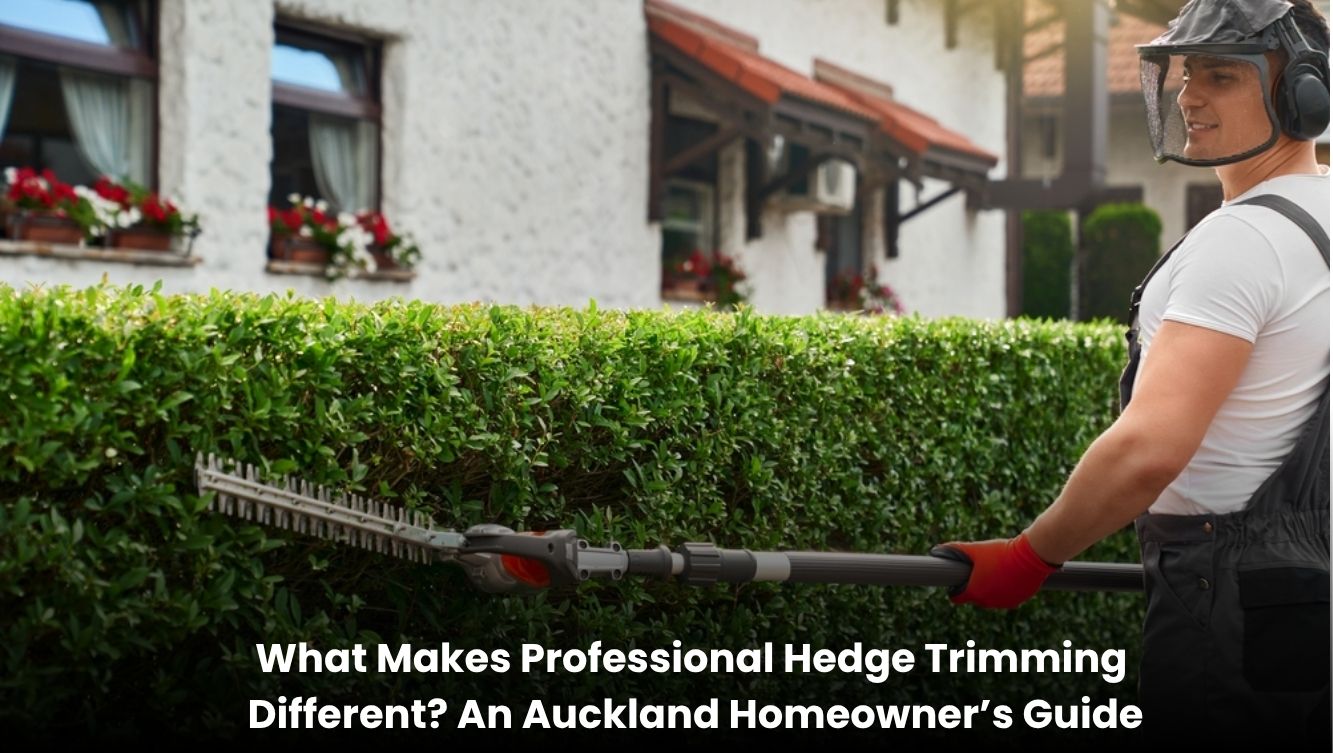
A hedge can change the entire appearance of a property. A neatly shaped hedge makes a garden look cared for, while an overgrown one can quickly make even a well-maintained home or commercial property feel untidy.
But good hedge trimming is not simply a matter of cutting branches until everything looks the same height.
The timing, cutting technique, plant type, growth pattern, tools, access, and final shape all matter. Cut too heavily in the wrong place and you can leave bare patches. Trim too little and the hedge continues to spread into paths, driveways, windows, or neighbouring areas.
For Auckland homeowners, this matters even more because gardens deal with regular moisture, changing weather conditions, and strong periods of plant growth. Hedges can become dense and unruly surprisingly quickly.
So, what makes professional hedge trimming different?
The short answer is knowledge, technique, consistency, and attention to the long-term health of the plant. Professional hedge cutting is not just about making a hedge look tidy today. It is about helping it remain healthy, manageable, and attractive as it grows.
This guide explains what experienced hedge care involves, the mistakes property owners commonly make, and how professional hedge trimming services can make garden maintenance easier.
Quick Answer: What Is Professional Hedge Trimming?
Professional hedge trimming is the careful shaping and reduction of hedge growth using the correct tools, cutting techniques, timing, and safety practices for the plant and property. The aim is to control size and shape while supporting healthy, even growth.
In simple terms, a professional does not simply ask, “How much can I cut?”
They ask, “Where should I cut, how much should I remove, and what will this hedge look like as it grows back?”
That difference can have a major effect on the result.
Why Hedge Trimming Is More Than Making a Hedge Look Neat
Hedges have several jobs around an Auckland property.
They can provide privacy, define boundaries, soften fences, reduce visual exposure, frame entrances, and create structure within a garden. On commercial properties, well-maintained hedges can also contribute to a cleaner and more professional first impression.
Without regular maintenance, however, growth can become uneven.
Branches may extend over footpaths. Leaves can become dense on the outside while the inside becomes sparse. Lower sections may lose sunlight. Some plants can develop woody growth that becomes harder to correct later.
Regular hedge trimming helps prevent these problems from becoming difficult and expensive to manage.
A well-maintained hedge should generally:
- Have a consistent shape
- Be appropriate for its available space
- Have controlled outward growth
- Maintain healthy foliage
- Avoid unnecessary bare patches
- Keep paths, windows and access areas clear
- Complement the surrounding garden
The goal is not to make every hedge perfectly geometric. The right shape depends on the plant and the property.
What Do Professional Hedge Cutting Services Actually Do?
A professional service normally starts with an assessment rather than immediately switching on the trimmer.
An experienced gardener looks at the hedge’s current condition, identifies excessive growth, considers its location, and determines how much can safely be removed.
This is especially important when dealing with mature or overgrown hedge trimming.
1. Assessing the hedge
Before cutting, professionals consider:
- Plant type
- Current height and width
- Density of growth
- Dead or damaged branches
- Previous trimming patterns
- Nearby buildings and structures
- Fences and property boundaries
- Footpaths and driveways
- Desired final shape
This assessment helps avoid aggressive cutting that may damage the appearance or health of the hedge.
2. Choosing the right cutting approach
Not every hedge should be treated in exactly the same way.
Some hedges respond well to regular light trimming. Others need more careful pruning to restore their shape. Mature hedges may require staged reduction rather than one severe cut.
That is where professional hedge cutting differs from a quick DIY job.
The cutting method is adapted to the condition of the hedge rather than applying one technique to every plant.
3. Creating a practical shape
A hedge should look good, but it also needs to remain manageable.
Professionals generally consider how new growth will develop after trimming. A hedge that is cut excessively wide at the top, for example, can create problems as it becomes heavier and denser.
Good shaping is therefore about both appearance and future maintenance.
4. Clearing the work area
Professional garden maintenance should not end when the cutting stops.
Leaves, branches and clippings need to be collected and the surrounding area left tidy. Paths, lawns and driveways should remain usable rather than being covered with hedge debris.
That finishing work is a small detail, but it makes a noticeable difference to the overall service.
Why Timing Matters in Auckland
One of the most overlooked parts of hedge maintenance is timing.
Auckland’s conditions can support vigorous garden growth, particularly when moisture and favourable temperatures combine. That means a hedge can move from neatly controlled to noticeably overgrown faster than many homeowners expect.
There is no single trimming schedule that works for every hedge.
Growth rate depends on the plant, its location, available sunlight, soil conditions, weather, and the level of shaping required.
A useful rule for homeowners
Do not wait until a hedge has completely taken over a space before thinking about maintenance.
Light, regular attention is often easier than trying to correct years of uncontrolled growth in one session.
For homeowners in areas such as Auckland, North Shore, West Auckland, South Auckland and surrounding communities, local growing conditions should be considered when planning garden maintenance.
The Biggest DIY Hedge Trimming Mistakes
DIY maintenance is not necessarily a bad idea. Small hedges that are easy to access can often be maintained by homeowners.
Problems arise when cutting becomes too aggressive or inconsistent.
Mistake 1: Cutting too much at once
A homeowner may look at a large hedge and think, “It needs to come down by half.”
That approach can leave an unattractive structure with little healthy foliage and may make recovery difficult.
For heavily overgrown hedges, gradual correction may be more appropriate.
Mistake 2: Ignoring the hedge’s natural growth pattern
Every plant grows differently.
Some become dense quickly. Others produce more growth on the outer surface while the interior becomes woody.
Simply cutting the visible surface repeatedly can create a hedge that looks green from the outside but has poor internal structure.
Mistake 3: Using blunt or unsuitable equipment
Poorly maintained cutting equipment can produce rough or damaged cuts.
Sharp, suitable tools allow cleaner work and better control.
Professionals also use different equipment depending on hedge height, thickness and access.
Mistake 4: Focusing only on height
A hedge is three-dimensional.
Reducing the height while ignoring the width can leave it growing over paths, windows, fences or neighbouring spaces.
A proper trimming job considers height, width and overall form.
Mistake 5: Leaving clippings behind
Small amounts of organic material can disappear naturally, but large quantities of hedge waste left around a property can make the garden look unfinished.
Waste removal and cleanup are therefore an important part of quality garden maintenance.
When Is Overgrown Hedge Trimming a Professional Job?
A hedge that has been neglected for several seasons can become difficult to manage.
Branches may be thick, woody and tangled. Access can also become challenging if the hedge is close to a wall, fence, driveway or building.
Overgrown hedge trimming is best approached carefully because removing too much growth at once can create a poor result.
A professional can assess whether the hedge needs routine trimming, selective pruning, staged reduction, or more extensive garden maintenance.
Signs your hedge may need professional attention include:
- It has grown beyond its intended boundary
- Branches are blocking windows or paths
- The hedge is becoming wider every season
- Lower sections are becoming sparse
- Growth is uneven or badly shaped
- Branches have become thick and woody
- The hedge is too tall to trim safely
- Previous trimming has created uneven sections
The sooner the problem is addressed, the easier it is usually to maintain the hedge.
Residential Hedge Trimming: What Homeowners Should Expect
For residential properties, hedge maintenance is often about finding the balance between appearance, privacy and practicality.
A hedge may separate a front garden from the street, provide privacy in a backyard, or form a boundary between neighbouring properties.
Residential hedge trimming should maintain the hedge’s purpose without allowing it to dominate the property.
For example, a privacy hedge may need to remain relatively tall, while a hedge bordering a driveway may need tighter width control.
A professional gardener can also look at the hedge in relation to the rest of the garden.
That matters because a hedge should not visually overwhelm lawns, garden beds, trees or outdoor living areas.
Commercial Hedge Trimming Requires a Different Approach
Commercial properties often have larger areas and stricter presentation requirements.
Retail properties, offices, rental properties, body corporates, schools and other commercial sites may need regular commercial hedge trimming to keep entrances, boundaries and shared outdoor spaces presentable.
Here, consistency is particularly important.
A hedge that is neatly maintained along one section but heavily overgrown elsewhere can make the entire property look neglected.
Professional garden maintenance can help businesses keep outdoor areas under control without requiring staff to spend their working hours dealing with garden tasks.
Hedge Trimming vs Hedge Pruning: Are They the Same?
Not exactly.
Hedge trimming usually refers to controlling the shape, size and surface growth of an established hedge.
Hedge pruning can involve more selective removal of branches to improve structure, remove damaged growth, manage density, or encourage healthier development.
This distinction matters when choosing hedge pruning services.
If a hedge simply needs routine shaping, trimming may be sufficient. If it has damaged, crowded or problematic growth, more selective pruning may be required.
An experienced gardener knows when routine trimming is enough and when the hedge needs a more careful approach.
How Professional Hedge Trimming Supports Better Garden Maintenance
A hedge does not exist in isolation.
Its growth affects the surrounding lawn, garden beds, pathways and other plants.
When a hedge becomes too wide, it can reduce usable space. When it grows heavily over a lawn, it can make mowing more difficult. When branches block garden beds, they may interfere with access and maintenance.
That is why hedge care fits naturally into a wider lawn and garden maintenance plan.
A property may benefit from combining:
- Hedge trimming
- Lawn mowing
- Garden clean-ups
- Weed management
- General garden maintenance
- Green waste removal
- Seasonal pruning
- Property tidy-ups
The advantage is consistency. Instead of dealing with individual problems only when they become obvious, homeowners can maintain the property as a complete outdoor space.
A Simple Professional Hedge Maintenance Process
For homeowners wondering how the job normally works, the process can be broken down into a few straightforward stages.
Step 1: Inspect
Identify the plant, growth level, access requirements and desired result.
Step 2: Plan
Decide how much growth should be removed and what final shape is practical.
Step 3: Trim or prune
Use appropriate equipment and techniques to control growth without unnecessary cutting.
Step 4: Check the shape
Step back from the hedge and inspect it from different angles. This is where uneven sections are identified and corrected.
Step 5: Clean up
Remove clippings and leave paths, lawns and surrounding areas tidy.
Step 6: Plan the next maintenance visit
Regular maintenance prevents the hedge from returning to the same overgrown condition.
This final step is often what separates reactive garden work from proper garden care.
Practical Tips for Auckland Homeowners
You do not always need a professional for every small garden task. Homeowners can make hedge maintenance easier by paying attention to a few simple habits.
Check the hedge regularly. A quick inspection every few weeks can reveal growth problems before they become obvious.
Do not wait for severe overgrowth. Small amounts of regular maintenance are generally easier to manage than major corrective work.
Look at the base as well as the top. A hedge can appear healthy at eye level while becoming sparse underneath.
Keep paths and access areas clear. Growth should not gradually take over walkways, entrances or driveways.
Think about the future shape. Do not trim only according to how the hedge looks today. Consider where new growth will develop.
Use appropriate safety precautions. Tall hedges, awkward access, electrical equipment and difficult cutting positions can turn a simple job into a safety risk.
If a hedge is tall, heavily overgrown or difficult to access, professional assistance is usually the sensible option.
What Garden Experts Brings to Professional Hedge Care
Garden Experts approach hedge maintenance as part of complete property care rather than treating trimming as an isolated cutting job.
For homeowners and businesses, that means looking at the hedge in context: how it affects the lawn, garden beds, access areas, boundaries and overall appearance of the property.
Garden Experts provides professional lawn mowing, lawn care and garden maintenance services for properties that need regular outdoor upkeep. This can be particularly useful for homeowners who want their gardens maintained consistently rather than waiting until growth becomes difficult to control.
The practical value of an experienced gardening team is not simply the equipment they bring.
It is knowing what to cut, what not to cut, how much to remove, how to shape the plant, and how the result will develop after the job is finished.
That judgement becomes increasingly important with mature hedges and larger properties.
The Future of Hedge Maintenance: Less Reactive, More Planned
Garden maintenance is gradually moving away from the idea of doing everything only when it becomes a problem.
For busy homeowners and property managers, planned maintenance makes more sense.
Regular visits allow small growth issues to be addressed before they become major jobs. This can help keep hedges at a manageable size and reduce the need for severe corrective cutting.
There is also growing interest in garden maintenance that considers the whole property rather than individual tasks.
For example, a lawn mowing visit can also identify hedge growth blocking a pathway. A garden clean-up can reveal branches that need attention. Routine maintenance can highlight areas where drainage, access or plant density is becoming an issue.
That wider view is valuable because a healthy-looking garden is usually the result of many small maintenance decisions working together.
Final Takeaway: Good Hedge Trimming Is About More Than Cutting
Professional hedge trimming looks simple when you see the finished result.
The difficult part is knowing how to achieve that result without damaging the plant, creating an awkward shape, or allowing the same problem to return a few months later.
For Auckland homeowners and businesses, regular hedge care can improve privacy, property presentation, garden access and general outdoor maintenance.
The biggest difference between an occasional cut and professional hedge trimming is often the thinking behind the work.
Professionals assess the hedge, understand its growth, choose the appropriate technique, work safely, shape it carefully and clean up properly.
If your hedge is becoming difficult to control, has grown beyond its intended space, or simply needs regular attention, professional hedge trimming services can take one more maintenance task off your list.
GardenExperts can help homeowners and businesses combine hedge care with lawn mowing, lawn care and wider garden maintenance, making it easier to keep outdoor spaces tidy, healthy and manageable throughout the year.
Frequently Asked Questions
1. What is the difference between professional hedge trimming and DIY trimming?
Professional hedge trimming combines plant knowledge, appropriate equipment, safe working methods and careful shaping. DIY trimming can work for small, accessible hedges, but professional help is useful when growth is tall, dense, overgrown or difficult to manage.
2. How often should hedges be trimmed in Auckland?
There is no single schedule for every hedge. Growth rate depends on the plant, weather, location and desired shape. Regular inspections and maintenance are better than waiting until the hedge becomes severely overgrown.
3. Can professional hedge trimming remove an overgrown hedge?
Yes, but the approach depends on the hedge’s condition and plant type. Severe overgrowth may require careful reduction rather than removing a large amount of foliage in one session.
4. Are hedge trimming services suitable for commercial properties?
Yes. Commercial hedge trimming can help offices, retail properties, rental properties, schools and other sites maintain neat boundaries, entrances and outdoor areas.
5. Is hedge trimming the same as hedge pruning?
No. Trimming mainly controls the size and shape of an established hedge, while pruning can involve selective removal of branches to improve structure, manage growth or address damaged sections.
6. When should I hire professional hedge pruning services?
Consider professional help when a hedge is too tall, heavily overgrown, difficult to access, badly shaped, blocking paths or windows, or has thick woody growth. Professional maintenance can also help prevent the hedge from becoming difficult to manage again.